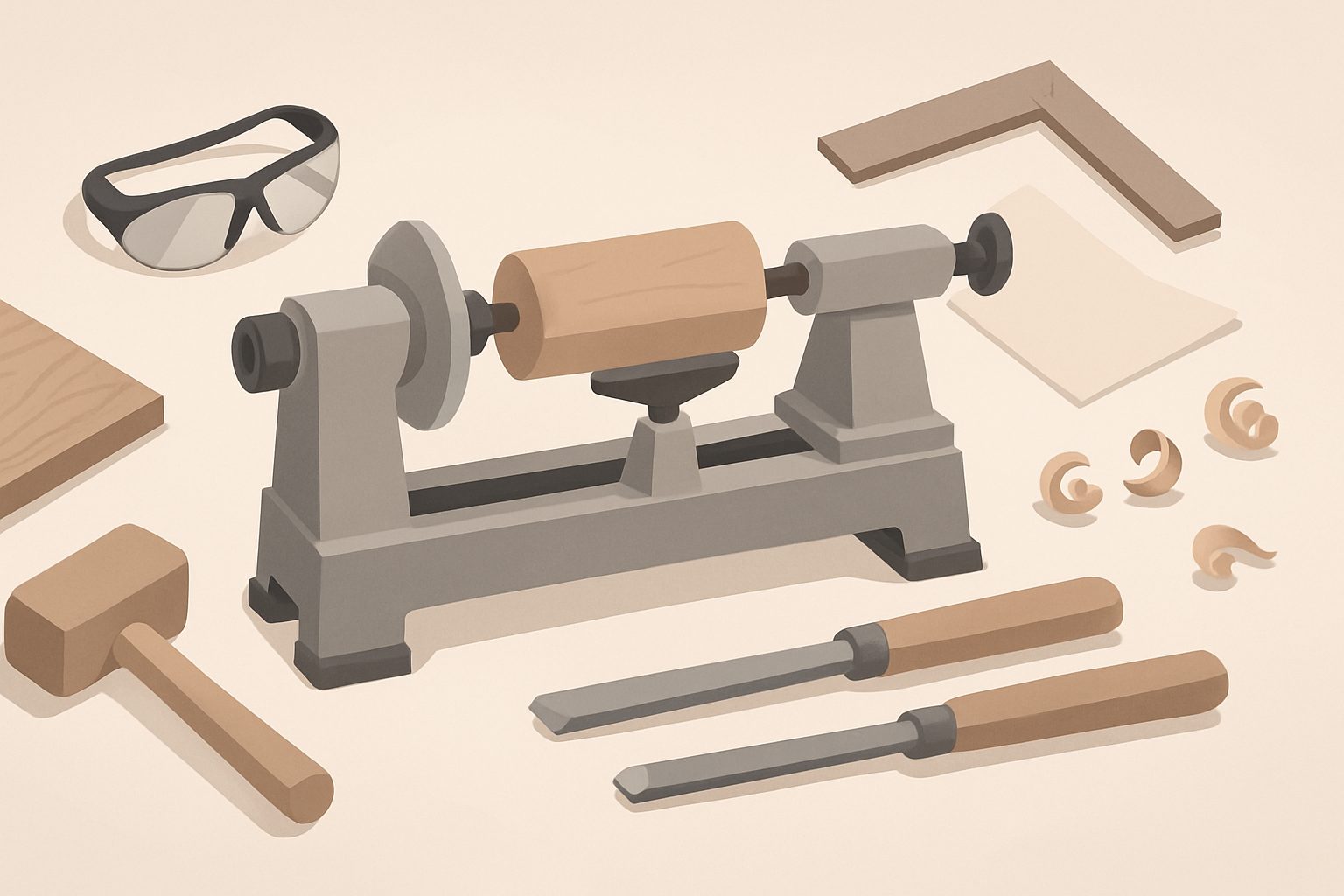
Best Mini Wood Lathes for Small Spaces UK – Compact & Capable
If your workshop fits in the corner of a garage or you're setting up in a garden shed, you've probably already realised that full-size wood lathes aren't realistic. A benchtop or mini lathe, though, gives you genuine turning capability without consuming your entire workspace. The trick is finding one that doesn't sacrifice too much functionality for the sake of size.
Small-space turning has genuine limitations—you're working within a smaller swing, shorter bed, and lower power. But that's not necessarily a dealbreaker. Most mini lathes handle spindle turning, small decorative pieces, and even modest bowl work without complaint. The real advantage is that you can actually leave the lathe up, which means you're more likely to use it.
What Makes a Mini Lathe Suitable for Tight Spaces
Beyond just being physically small, the best mini lathes for constrained workshops share a few key traits. Weight and footprint matter enormously: a lathe that tips over if you lean on it, or that takes up your entire bench when mounted, defeats the purpose. You want something stable enough to handle reasonable turning speeds yet genuinely portable or easy to store.
Power is another consideration. A 1–1.5 HP motor is the realistic sweet spot for benchtop models. Anything less struggles with catch resistance; anything more is overkill for the small work you'll typically do.
Swing (the diameter of material you can turn) usually ranges from 250–330mm on mini lathes. That's perfectly adequate for spindles, small boxes, and off-centre work. If you're dreaming of turning 12-inch bowls, you'll be frustrated. But for general turning practice and small finished pieces, it's enough.
Record Power DMLX
The Record Power DMLX is probably the most thoughtfully designed mini lathe for UK woodworkers with space constraints. It's compact—roughly 900mm long with a 250mm swing—and at around 40kg, it's genuinely moveable if you need to shift it.
The DMLX uses a belt-and-pulley system rather than electronic variable speed, which means it's mechanical, reliable, and less likely to develop faults. You get around 500–3,000 rpm, which covers everything from bowl turning to spindle work. The headstock slides along the bed to accommodate different workpiece lengths, which is practical if you're switching between short finials and longer spindles.
The chuck mounting is standard MT2, and the lathe accepts normal woodturning tooling. The bed is solid cast iron, so it absorbs vibration well for its size. Assembly from the box takes an afternoon, and the manual is reasonably clear.
The real honest limitation: a 250mm swing is snug. For anything wider than a small box blank, you're bumping against the theoretical maximum. Noise levels are higher than you'd expect for the size—the belt isn't balanced perfectly, and that buzzing will annoy neighbours in close quarters. It's not broken; it's just what you get at this price point.
Nova Comet II
The Nova Comet II occupies a middle ground: slightly more capable than the DMLX, but still genuinely compact. It offers a 330mm swing with a longer bed and 1.5 HP power. It's heavier (around 55kg) and bulkier, but still manageable in a dedicated shed or garage spot.
The Comet II uses electronic variable speed controlled via a variable frequency drive (VFD), which feels smoother and more responsive than belt systems. You can dial in exact rpms from around 400–3,200, which is genuinely useful when you're learning—low speeds for rough work, higher speeds for finishing. The smooth start-up is kind to your workpieces and your concentration.
Build quality is higher than the DMLX. The chuck mounting, toolrest design, and overall rigidity feel more substantial. If you're planning to spend real time turning rather than dabbling, this lathe feels more encouraging.
The trade-off: the VFD adds cost and complexity. If it fails, you're sending it back rather than tightening a belt. The 330mm swing is bigger, but it does mean the footprint is noticeably larger—check your workspace before committing. It's also noisier in a different way: the VFD produces a slight electrical hum that some people find intrusive.
Fox F28-224
The Fox F28-224 sits at the budget end. It's a lightweight, genuinely portable lathe—around 25kg—with a 210mm swing. Small, yes, but that's the whole point if space is your limiting constraint.
At this size, you're basically committed to spindle turning and small items. The 1 HP motor is adequate for what the machine is designed for. Crucially, it's British-made and stocked by UK suppliers with reliable local support, which matters when you're troubleshooting an unfamiliar tool.
The footprint is minimal, and because it weighs so little, you can clamp it to any sturdy bench and unclamp it when you're done. That flexibility is genuinely valuable in a shared workshop or if you're rotating tools around a small space.
The honest limitation: this is an entry-level lathe. The spindle bearings are simpler, the chuck isn't the smoothest to operate, and it won't last forty years of heavy use. But if you're learning turning in a tight space and want a tool you can actually store, the F28-224 delivers on that promise.
Choosing for Your Space
Pick the Record Power DMLX if you want reliability and simplicity in the smallest practical footprint. Choose the Nova Comet II if you're committed to turning and can sacrifice some portability for better speed control and build quality. Go with the Fox if space is absolutely critical and you're new to turning.
All three are genuinely capable tools for their size. The real question isn't which is "best"—it's which limitation you can live with.
More options
- Wood Lathes – General (Amazon UK) (Amazon UK)
- Record Power Wood Lathes (Amazon UK) (Amazon UK)
- Jet Wood Lathes (Amazon UK) (Amazon UK)
- Wood Lathe Chucks & Jaw Sets (Amazon UK) (Amazon UK)
- Woodturning Chisel & Tool Sets (Amazon UK) (Amazon UK)